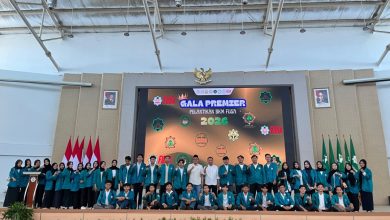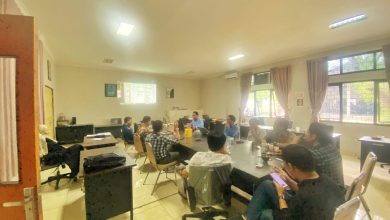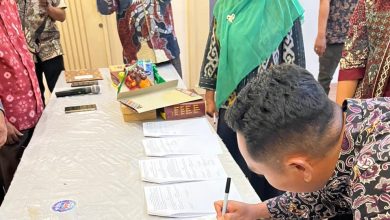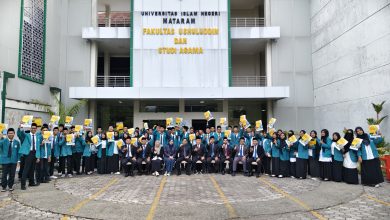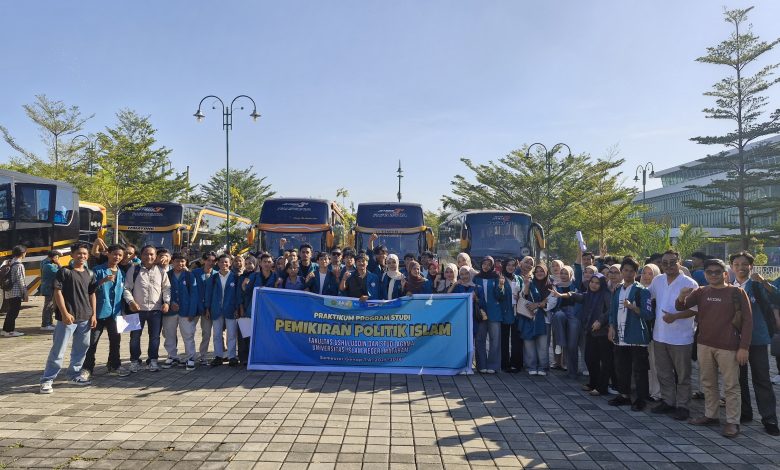
The Islamic Political Thought Study Program held an opening and briefing session for its practicum on Saturday, April 18, 2026, at Senggigi Tourism Village. This activity marked the beginning of practicums for students in several courses, designed to strengthen the connection between classroom learning and the social, political, and governmental realities of society.
On this occasion, the practicum covered five courses: Legislative Process for semester VI, Village Politics and Government for semester VI, Political Culture for semester IV, Social Research Methodology for semester IV, and Government Science for semester II. These five courses were aimed at providing more concrete academic experiences, so that students not only understood concepts theoretically but also were able to read socio-political dynamics directly, measurably, and reflectively.
The opening ceremony took place in a warm and solemn academic atmosphere. Students received initial training on practicum orientation, fieldwork ethics, academic discipline, how to build communication with the community, and the importance of maintaining integrity during observation, data collection, and analysis. This training was crucial to ensuring that the practicum was not merely a ceremonial activity, but rather a learning space that truly brought together knowledge, experience, and intellectual responsibility.
In his remarks, the Dean of the Faculty of Ushuluddin and Religious Studies emphasized the crucial role of practicums in building students' academic capacity. He argued that strengthening academic knowledge in higher education requires a concrete encounter between theory and social context. Students need to be accustomed to carefully reading reality, understanding the structure of social life, and developing critical, analytical, and responsible thinking. The Dean also emphasized that practicum activities are part of the faculty's endeavor to provide learning that is relevant to the needs of the times, without sacrificing the depth of scientific disciplines that underpin students' academic development.
The Head of the Islamic Political Thought Study Program, Muh. Alwi Parhanudin, MSI, in his comments stated that practicums are an important vehicle for fostering students' intellectual sensitivity to political and social life in a concrete form. He explained that each practicum course has a different emphasis, but all move towards one academic goal, namely to train students to be able to view problems conceptually and empirically. Through practicums, students are expected to learn to understand how the legislative process is thought through and implemented, how village government works in reality, how political culture develops in society, how social research is conducted methodologically, and how the basics of government science are recognized from the early stages of learning.
He also added that Senggigi Tourism Village was chosen as the location for the activity because it provides a rich learning environment for social and governmental observation. This environment allows students to observe the relationships between communities, local governance, the dynamics of interests, and patterns of social interaction, which are essential components of the study of Islamic Political Thought. Thus, the practicum does not stop at data collection but develops into an exercise in interpreting reality within a more mature academic framework.
Through this opening and briefing event, the Islamic Political Thought Study Program affirmed its commitment to continuously providing a learning process rooted in both theoretical reinforcement and rigorous field experience. Practicums are seen as a crucial part of developing students who are prepared to think seriously, work methodically, and understand socio-political realities more comprehensively.